8mm vs 16mm vs 35mm film grain: what the gauge changes
Put the same film stock through a Super 8 camera and a 35mm camera and the Super 8 footage looks far grainier. The grains are the same size. The difference is how much each frame has to be blown up to fill your screen.
It is all about frame size
Film grain is made of tiny clumps of silver or dye in the emulsion. Their size depends on the stock and its speed, not on the camera. What changes with the gauge is the area of the picture. A small frame has to be enlarged more to fill the same screen, so every clump gets enlarged with it.
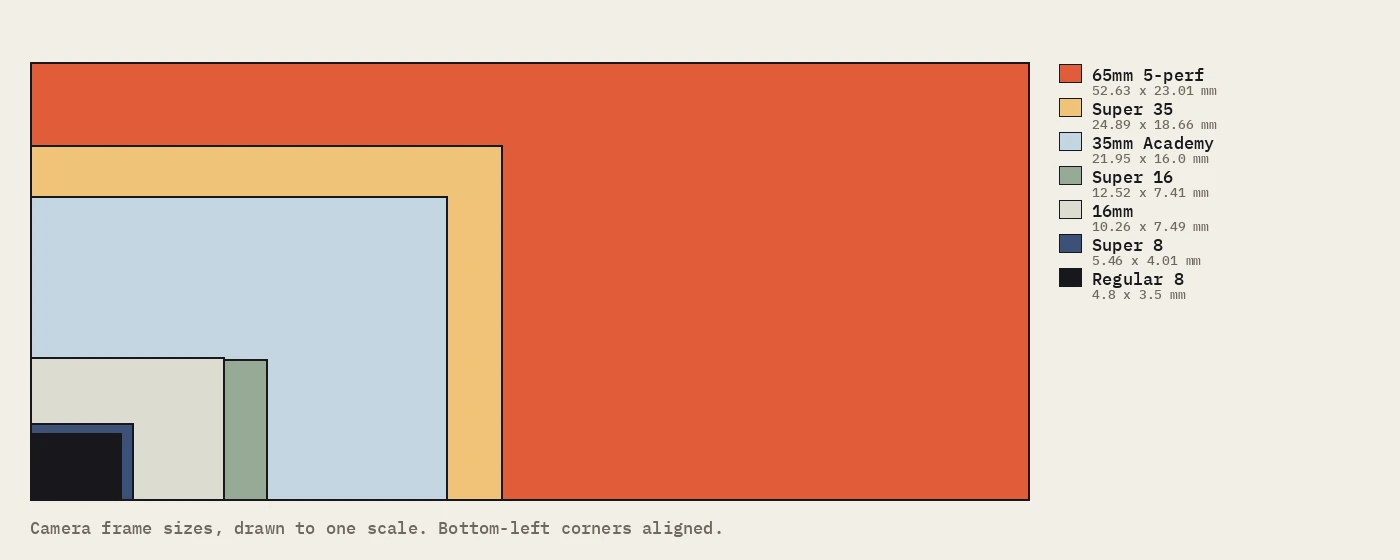
| Format | Frame (mm) | Area (mm²) | Enlarged vs Super 35 |
|---|---|---|---|
| Regular 8 | 4.8 × 3.5 | 17 | about 5.2× |
| Super 8 | 5.46 × 4.01 | 22 | about 4.6× |
| 16mm | 10.26 × 7.49 | 77 | about 2.4× |
| Super 16 | 12.52 × 7.41 | 93 | about 2× |
| 35mm Academy | 21.95 × 16.0 | 351 | about 1.1× |
| Super 35 | 24.89 × 18.66 | 464 | 1× |
| 65mm (5-perf) | 52.63 × 23.01 | 1211 | about 0.5× |
The last column compares frame widths. To fill the same screen, a Super 8 frame is enlarged about 4.6 times more than a Super 35 frame, so the grain looks about 4.6 times bigger. Sizes are camera apertures as listed on Wikipedia's pages for each format.
What that looks like
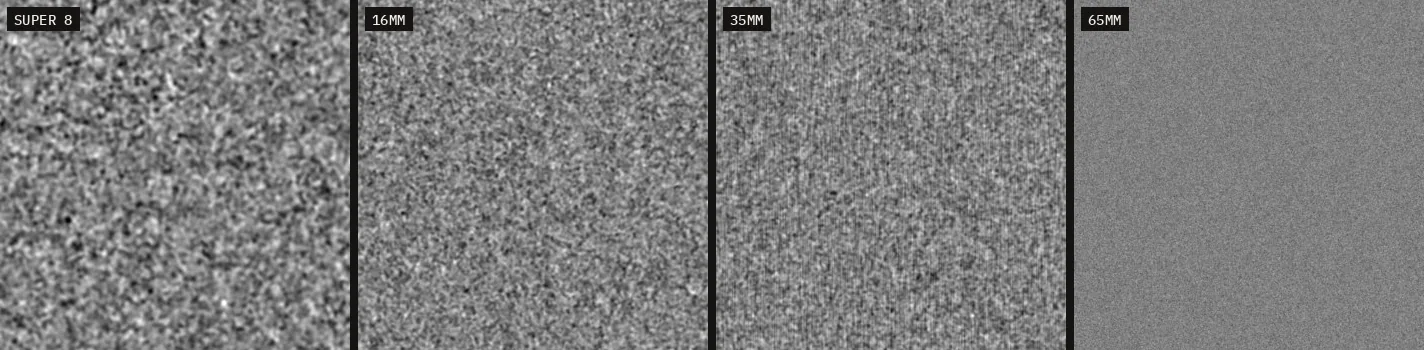
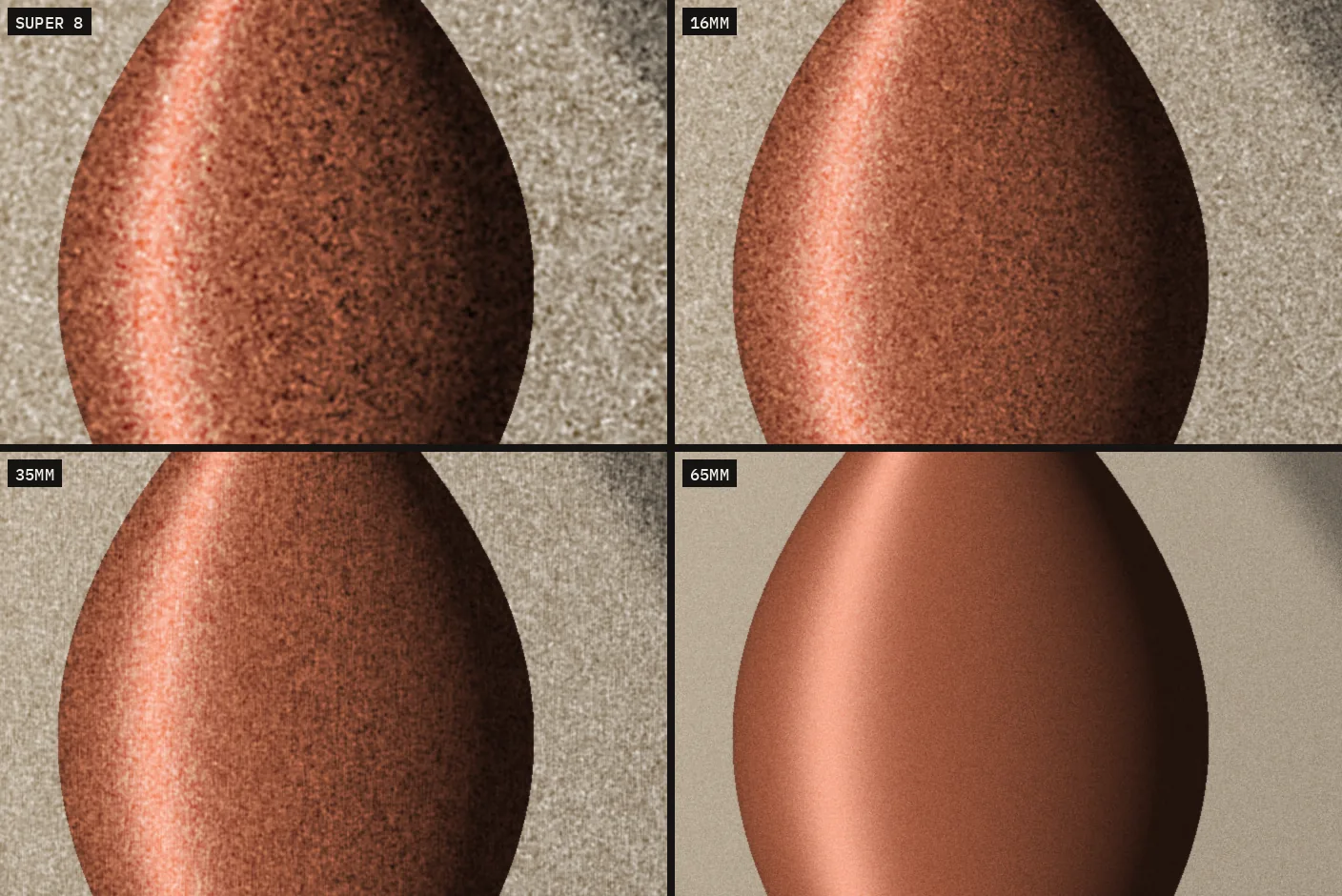
These are crops from four of our plates at 100%, with no scaling. They are not scans. Each plate is generated with code and tuned to give the grain size and character of that format, so you can see the trend clearly.
The character of each format
Super 8 and Regular 8
Home movies, music videos, flashbacks. The grain is big and busy and it is never subtle. Pair it with soft focus, warm colour and a few light leaks, because 8mm footage rarely looks sharp and clean. Our faded home movie plate adds the colour fade as well.
16mm and Super 16
The documentary and indie look. The grain is clearly visible but no longer the main thing in the frame. Super 16 has a wider frame than standard 16mm, which is why it was popular for widescreen TV: a little less enlargement, a little finer grain.
35mm
The standard feature-film look. On a modern screen the grain is a texture you feel more than see. If you want people to notice grain, 35mm is usually too subtle. If you want a digital image to stop looking plastic, it is the right choice.
65mm
Large-format epics. The grain is so fine that it mostly just softens hard digital edges. Use it when you want "shot on film" without anyone being able to point at the grain.
Gauge is only half of it
Stock speed changes grain as much as the gauge does. A fast stock on 35mm, or a slow stock pushed two stops in development, can look grainier than a slow stock on 16mm. Black-and-white grain also looks sharper and harsher than colour grain, which is softer because it is made of dye clouds. If a plate named after a format looks wrong for your image, try a different speed in the same format before you switch formats. All of them are on the film grain page, grouped by film speed and format.
Using a grain plate
- Place the plate over your image and stretch it to cover the frame.
- Set the layer's blend mode to
Overlay(orSoft Lightfor a gentler result). Our plates sit on 50% grey, which disappears in Overlay. - Lower the opacity to taste. 40–70% is a good range for most photos.
Step-by-step versions for Photopea and Photoshop are in the guides.
A note for video. These plates are stills. One still grain frame over moving footage looks like dirt on the lens, because real grain changes every frame. For video, use moving grain, or at least swap between several plates every frame. For photos, thumbnails and single frames, a still plate is exactly right.